
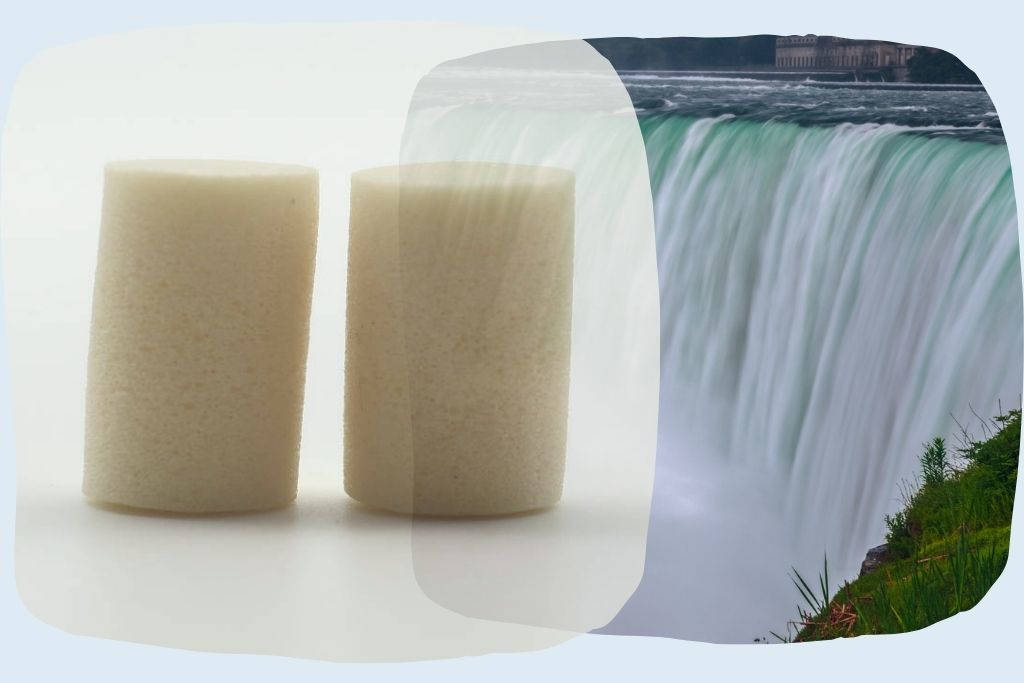
Earplugs keep noise from reaching your ear drums by absorbing and reflecting sound energy.
They can very effectively reduce annoying noises at all frequencies we can hear, provided they fit well.
In contrast to this, a white noise machine does its magic by adding noise to your environment:
It creates a waterfall-like sound to mask (=drown out) annoying background noises so that they become less noticeable or even completely disappear.
Imagine yourself in a library.
One person is whispering, and another one coughing. And, these old wooden chairs are timed to creak at the worst possible moments.
With earplugs in your ear, the whispering and creaking and all the other “little noises” are gone. The occasional coughing is still noticeable but a lot quieter.
Now imagine yourself close to a waterfall (=a white noise machine).
At a distance, a group of children is playing: they are laughing and shouting—and throwing rocks.
But if you closed your eyes, you wouldn’t know.
Chances are that all you hear is the sound of the water gushing down.
Perhaps you feel the waterfall is too loud for comfort.
So you put in your earplugs, and now this waterfall has just the right volume.
You relax and fall asleep.
Did someone cough? You have no idea.
The Lesson: Both earplugs and white noise are very effective noise fighting tools, and in many cases they work best together.
This post helps you decide what is right for your bedroom.
Contents
A closer look at earplugs
Earplugs, in particular foam earplugs, are good at reducing noise across the whole frequency range of human hearing.
This includes truck rumble, snoring, barking dogs, chatter, and chirping birds and crickets.
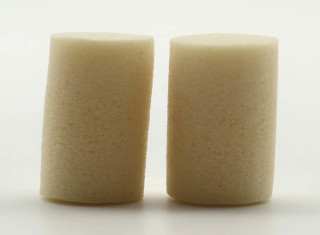
Here is the noise attenuation table for the cylindrical Flents Quiet Please (one of my current favorites) with a noise reduction rating of 29:
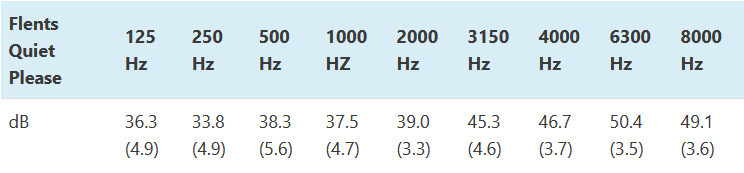
As you can see, the noise reduction effectiveness varies with the frequency:
With optimal earplug insertion, we are looking at >30 decibels at lower frequencies and up to 50 dB at high frequencies, both of which are very good.
Some foam earplugs are even good at frequencies well below 125 Hz.
For example, the humble Quiet Please (shown above) substantially reduces even truck noise (30 – 40 Hz).
Note: It does that for me because I can insert it very deep and still be comfy. Earplug fit is everything when it comes to blocking low-frequency noise. YMMV.
With this amount of noise reduction, most background noises (e.g., creaking, the sound of the AC, road noises) disappear from your bedroom, leaving you with a quiet environment.
But earplugs don’t block all noise.
Loud snoring, a loud TV in an adjacent hotel room, crickets outside the window, or a dog barking in the next apartment will be quieter, but can still be heard.
For more info on which earplugs to choose, take a look at these articles:
The Best Earplugs for Sleeping – and a Way to Boost Their Performance
The 5 Best Earplugs for Small Ears
Pros of earplugs
- Very effective at reducing noise across the whole frequency range.
- Can completely eliminate quieter intermittent noises (clicking, AC or fridge compressor turning on, creaking…) that would startle or annoy you. These noises are pushed below the threshold of hearing.
- Effectively reduce louder noises (snoring, barking, traffic) so that they are less likely to wake you up.
- Good also for side sleeping.
- Some earplugs are quite good even at reducing low frequency noise (truck rumble, bass, stomping), which is very hard to do.
Cons and challenges of earplugs
- You have to plug your ears.
- Foam earplugs are overall the most effective ones, but they take practice to insert well.
- You may have to experiment with different earplugs to get the deep seal necessary for optimal noise reduction and still remain comfortable.
- Snoring, barking, footfalls, and crickets become a lot quieter, but your brain can still focus on them, potentially keeping you from falling asleep.
- Earplugs that seal at the ear canal entrance such as wax and silicone earplugs are comfy, but can amplify body generated sounds (e.g., heartbeat, pillow or bed sounds conducted into the skull). This bothers some people.
- Because they block most noise, tinnitus that would otherwise be partially masked (by the noise background) can become more noticeable.
A closer look at white noise

Strictly speaking, white noise is broadband noise with equal intensity at all sound frequencies. For most purposes it is too high-pitched and sounds a bit harsh.
In this post (and most of the Internet) white noise refers to a family of fairly constant sounds that cover a large frequency range but can have various frequency spectra / pitches.
Included are for example:
- True white noise, pink noise, brown noise, dark brown noise, etc.
- Waterfall sounds, rain sounds, and other nature sounds that cover a large spectrum.
Many white noise sleep studies were, in fact, done using pink noise (which decreases moderately in intensity with increasing sound frequency).
Here is a short sample of pink noise.