AirPods Pro 2 have an upgraded, powerful active noise cancelling function that can make a gas-powered lawn mower, many power tools and other machinery and even music bass appear a lot quieter.
Sometimes the results are stunning.
Perhaps you are wondering:
“Why not get rid of earplugs and ear defenders and use my AirPods Pro instead? They are more comfortable, seem to be doing the job, and I can also listen to music.”
I hate to disappoint, but I would not use AirPods Pro as a hearing protector!
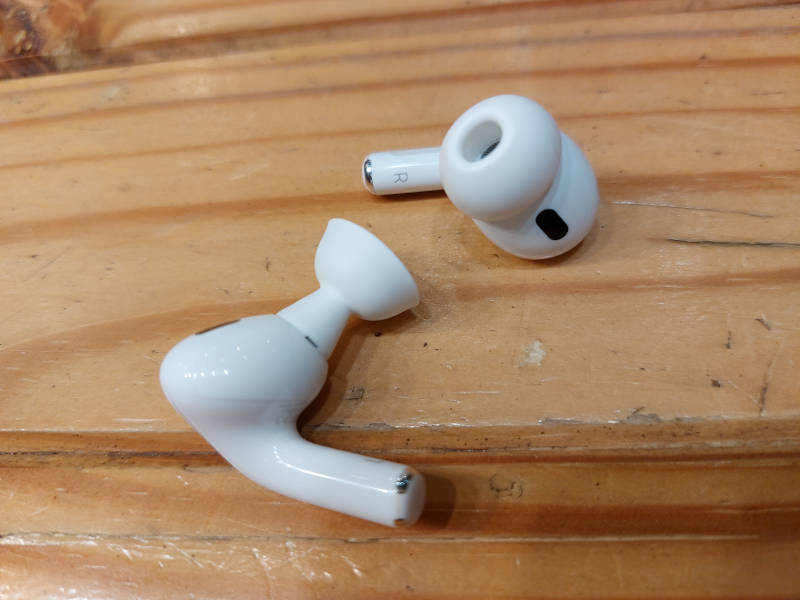
Take a look at the ear tips. Flip them over and squeeze them a bit.
They offer very little resistance when you squeeze them.
This is good for consumer earbuds because most people don’t want to feel any pressure in their ear.
Provided the tips fit your ear, they are also good for taking the edge off of noise and helping with noise sensitivities.
I find them very comfortable.
But can you rely on these tips to reliably protect you from noise levels that might damage your hearing?
I cannot.
When I raise my eye brows and thereby change the shape of the ear canal, the environmental noise level changes substantially, i.e., noise seeps in. So the seal is not consistent.
A good place to try the ear canal squeeze test is alongside a busy road. Make sure you get a good seal first (so that the active noise cancelling function works well), otherwise you won’t notice a difference.
Other points to consider with respect to the ear tip fit:
Your initially good seal will get affected by the vibrations of your mower, the hammer blows, your dance moves, etc. Think about it: how often do you have to readjust the fit of your AirPods?
Often the earbuds work themselves out over time. And if you additionally listen to music, you may not even notice that the seal has deteriorated.
Actual work earplug headphones (with a noise reduction rating) and earplugs typically press much more vigorously against your ear canal wall to maintain a consistent seal even when you are in motion.
Unlike AirPods, work earplug headphones (and Bluetooth ear defenders) generally limit the maximum audio volume to 82 or 85 decibels. This limit makes it much harder to inadvertently drown out hazardously loud external noise or compensate for a poor seal with even louder music.
AirPods’ tips are designed for wearing comfort and taking the edge off of everyday noise, not hearing protection!
How about adaptive transparency mode, a new feature on the AirPods Pro 2?
Some bloggers have suggested this feature to protect you at loud concerts.
In transparency mode, you hear your environment via the outward-facing microphones.
In adaptive transparency mode, the Pro 2 additionally attempt to control the noise level reaching your ears by limiting the earbud speaker output (in my tests to about 85 dB).
Given the excellent sound quality of AirPods’ transparency mode, one could be tempted to use them at a loud event.
But, if your ear tips don’t isolate your ears well enough or the seal isn’t consistent (e.g., because you are dancing), hazardous sound levels will reach your ears directly (just not via the speakers if the limiter works well).
Even in adaptive transparency mode, the maximum achievable noise attenuation is limited by your ear tips. As I mentioned earlier, I would not rely on them.
Surely the powerful active noise cancelling function (ANC) can help?
It is the adaptive ANC of the AirPods Pro that at times seems to almost mute constant lower-frequency noises, e.g., those from your mower, certain power tools, trucks, and even music bass.
That’s what creates the “wow-effect.”
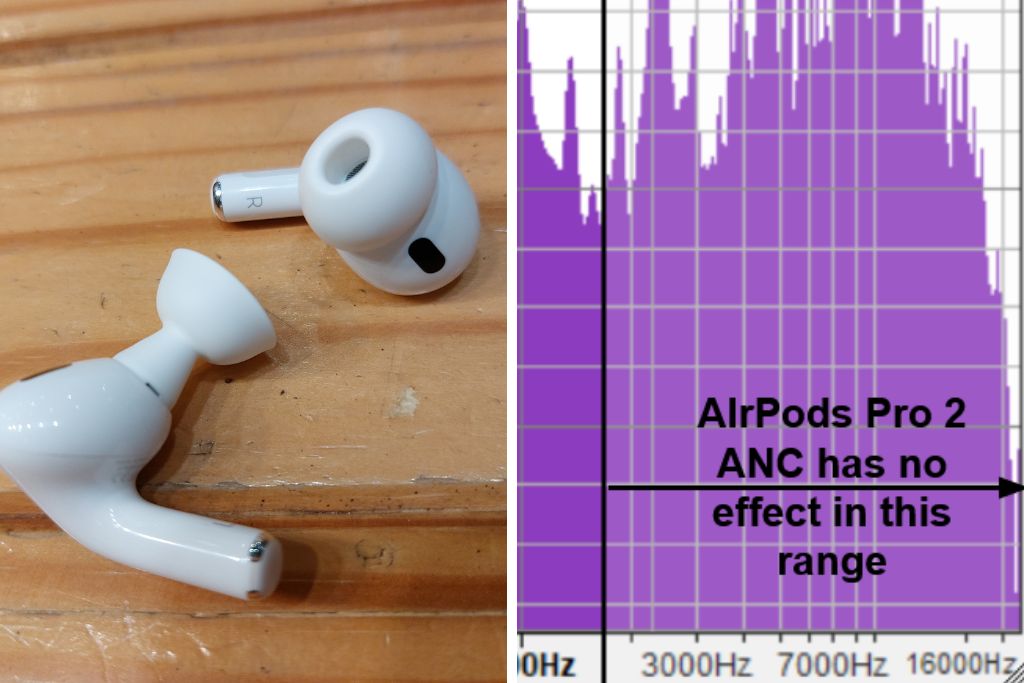
Unfortunately, against higher-pitched noises, the ANC is ineffective. In my tests, there was no benefit beyond 1600 Hz.
The ANC of the Pro 2 actually covers a very good range. Many other ANC earbuds have a lower cutoff frequency!
But consider this: depending on the material you are working with, grinders, metal saws, etc. will emit potentially hazardous noise at much higher frequencies.
Here is a short noise sample of a construction worker using an angle grinder on metal.